
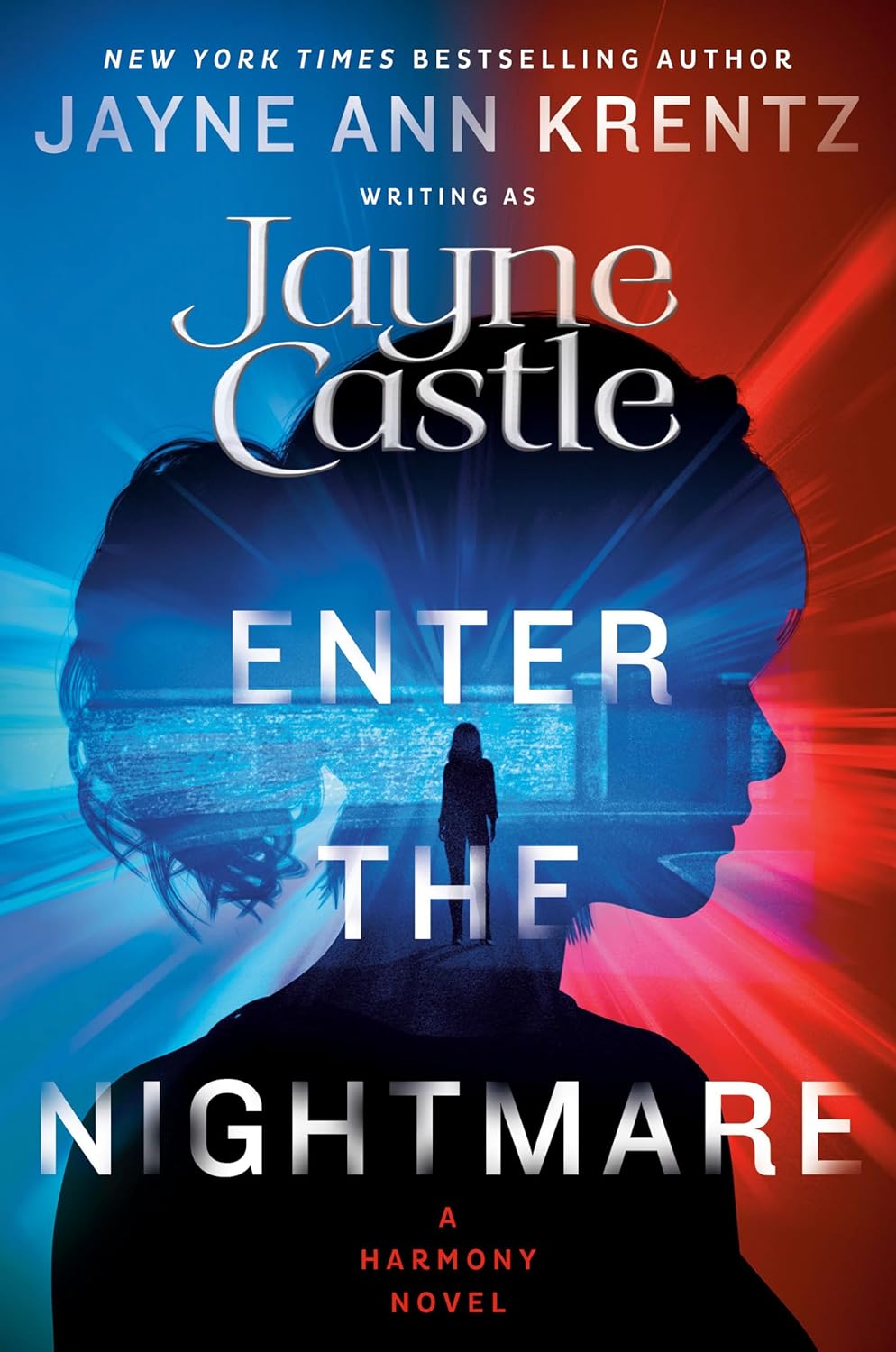
Let me set the scene: it’s dumping down snow in the first week of May, and I’m sitting in the makeshift office I’ve crafted for myself by the fireplace. The lighting is terrible, and the house is freezing, so I’m wearing a ridiculous fuzzy sweatshirt, totally ready to sit down on Zoom with New York Times Bestselling author Jayne Ann Krentz. Her latest book, Enter the Nightmare, on shelves June 30th, is the 19th book in her Harmony series. In addition, she’s written romantic suspense across subgeneres, most notably historical, under the pen name Amanda Quick. Krentz is a living legend, and I am deeply grateful she chose to spend her time talking to me on this snowy afternoon.
You are a prolific writer with a sweeping career that crosses genres. It’s truly impressive to be able to write in so many different genres, so successfully. How did you get your start?
First of all, I should specify that I always write romantic suspense. There’s always a murder, there’s always a relationship. So as far as I’m concerned, I don’t write in a lot of different genres. What changes is the world that I’m writing against.
That has actually turned out to be probably the most useful thing I did with my career, because it keeps me fresh, going from one world to the other. It’s a very refreshing experience. If I had just stuck with one, either the contemporary, the historical, or the futuristic, for all these decades, I think I would have gotten bored with it. If you like my characters in one world, you’re probably going to like them in the other, and if you don’t like the one world, you’re probably not going to like them in the other.
The storylines are always gonna be romantic suspense. And I got my start because, oh, I can’t remember now, back in the ’80s and ’90s, the whole romance boom just took off. The romance market for the books, the whole genre just suddenly was, as genres happen, they just exploded on you, all of a sudden. Nobody saw it coming, and then, oh, you look back, and we said, Oh, we should have seen it coming. It’s been very strong.
One of the benefits of the romance genre in general, and all these little sub-genres it contains, is that nobody cared enough about the genre to make rules; we weren’t stuck with the rules. The genre as a whole allows for a lot of different styles, stories, and worlds. You can’t just go plopping certain kinds of stories down in the mystery genre, for example. There are conventions, and you can’t violate the conventions.
Same with the literary genre. There are conventions from the literary genre, and you violate them at your peril. Women’s fiction. All the way down the line. But with romance and romantic suspense, nobody put down any rules until it was too late, and then we were off and running.
You were free. It’s one of the things I love as a reader in this space, that you can find so many different kinds of stories. People say that romance is formulaic, and I could not possibly disagree more because you just never know where a story’s going to take you or what world it’s going to be in. Is it going to be futuristic? Is it going to be historical? You can have just a buffet of tales in there.
It’s the reason I’ve never wanted to write anything else. There’s never been a time when my story wouldn’t fit somewhere in the genre. Now, this is my happy place.
Enter the Nightmare is the 19th book in the series, which is just crazy. How do you keep each story fresh, each story unique, in a series that spans that many books?
Well, the world continues to evolve because it’s an unknown world for the most part, so it gives me room to create new problems within that world. But for me, the key that I learned early on is that I am not good at writing a continuing set of characters. I need a new couple each time. I need a new set of problems each time.
So I never got tired of my characters, because they were always new. There may be some background characters who come and go, but the relationship is always fresh, and I get to work with it from scratch. And I think the problem for me, with writing continuing characters, the same character solving the crimes, et cetera, et cetera, for several books, would have been just, I don’t want to disrupt the relationship once I’ve created it. I don’t wanna tear it apart, and that’s kind of what you have to do, though.
I never was successful at writing the continuing characters, but I’m happy to work with the worlds. The futuristic world, the historical worlds, and I move around a bit. In my Amanda Quick worlds, I started out with the classic Regency romance, then moved to the late Victorian, then did the 1930s setting for a while. It’s not that static for me. And lately, I’ve really moved into the whole psychic thing, too, because that’s always been my first love.
I loved that element of this story, and particularly of Alice’s character and her powers and the dream aspect of it. I found that to be completely fascinating. And the Hotel of Dreams and that twist, not to spoil anything for anyone who’s going to be reading this, but I loved that twist. What were you feeling when you wrote that?
I should say that the wonderful thing about working with dreams and visions and nightmares and all of that is that the science is really still out there. We don’t really know that much about dreams. So you can do anything you want with them, and still make it seem fairly logical.
Lucid dreaming, for example, you can play with that indefinitely. I like using the psychic thing. Because it’s just one step, maybe two steps, beyond intuition. Most people can identify with intuitions, so it isn’t that hard to make believe into a psychic power.
I should point out that I often get labeled paranormal, and that’s technically true. I am in a paranormal setting. But as you and I know, in our world, paranormal has come to mean supernatural. It usually means werewolves or vampires and demons and magic. I don’t do that. If you’re looking for paranormal vampires, et cetera, not me.
One of the most fascinating things about reading your work is that it was very much billed as paranormal, but it’s this whole different branch of paranormal that’s futuristic. It’s a little bit sci-fi, and it’s not really paranormal at all, but I get why people call it that. It was a wonderful adventure.
I’m glad you enjoyed it. I do think if you were able to enjoy it, it’s probably because it doesn’t demand a belief in the supernatural. Most people have actually had what they will tell you is a psychic experience of some kind. Whether or not it is, we’ll never know.
Everybody believes in intuition. That makes it easy for me to work with, and it works for me, because I’m not into the whole supernatural world. I can read it and enjoy it, but I can’t write it. It doesn’t fit my characters.
I can see that, with your characters. They’re very grounded in realism, despite the dust bunny and certain elements that would be alien to us in the real world. Your characters are not. Which is part of what was interesting about it. Sebastian the dust bunny was my favorite thing. I loved that dust bunny.
Yeah, the dust bunnies have pretty well taken over that Jayne Castle world. I’d be afraid to do a book without them now.
Where did the idea for the Harmony world come from?
I wanted freedom to use the psychic thing to the full extent, to really play with it. That was difficult to push too far here on Earth, and still have it grounded in Earth’s history. I didn’t want to create a whole new history or an alternate history kind of universe. I just wanted a universe of my own that I could create from scratch.
So, I came up with the concept of the banded colony that had survived for 200 years, and it fought its way back from the brink, and was now a flourishing world that looks a lot like our world in the 21st century, but with this twist. The thing I learned about world-building is to start with the source of the energy. Start with the source of the power. In our world, it’s been fossil fuels for as long as any of us can remember.
I had that option to create a whole new source, and so I went with Amber. Which, as we know from grade school, does have “electrical properties”. All of our computers are stuffed with crystals in one kind or another, and silicon, and the whole bit. I figured it wasn’t that much of a leap to turn a certain kind of amber into basically the fossil fuel of this planet.
Once you’ve established a power source that works that way, then everything sort of spins off from that because that’s what runs your cities, it runs your car. Your life is going to have to revolve around how you deal with that kind of energy. That proved to be the smartest thing I did, even though at the time, it was just kind of a fun thing to do. It turned out to be a saving grace for plots in terms of the world.
For Alice and Owen’s story, you obviously had this world well established by the time these two characters came along in your brain. But do you start with fleshing out the characters, or do you start with the plot, the mystery, and the murder involved?
I usually need the plot and the mystery first, because my characters are going to react to that. I’m looking for something that makes me curious or makes me interested as a writer, because then I could make my characters interested in it. Their problems have to somehow be related to that, to the strangeness of their world that they’re trying to deal with.
On the other hand, they’re normal human beings trying to make a living, trying to get a job going, trying to, maybe, survive a nightmarish experience in a psychiatric ward, which could happen to anybody.
That was one of my favorite things about Enter the Nightmare. Alice is on the run from a hospital for the criminally insane, and the institutionalization of women who are not behaving is a long-standing theme in literature as a whole, in life as a whole. But in Harmony, it felt like something different. How did you come up with that wonderful backstory for Alice with this hospital?
It’s not the first time I’ve used a creepy psychiatric hospital’s background. I should start off by saying that, as far as I’m concerned, the Gothic novel is the foundational text of the romance genre, and in the Gothic novel, the question of sanity is always a huge element. There are three or four elements that, for me, make up the Gothic.
One of which is a woman isolated, on her own; there’s a real question of trust, she can’t really trust anyone around her. Everything is a risk when it comes to trust, and she has cause to question what she’s seeing with her own eyes. She has the cause to question her own sanity, and that gets played on by the bad guys. You’re just having a little breakdown, honey. Don’t you worry your pretty little head about it. You just sign these papers. It’s the basic gaslight concept.
So, whenever I write a story somewhere at the heart of it, it’s probably been fueled by my love of the classic Gothic novel. The question of sanity is always there. It comes from years and decades, thousands of years, of women being told you’re overreacting. Calm down, calm down. Your nerves are acting up. There’s a long history of that, and one of the reasons that has worked is because the woman in question is usually isolated in some way. She has no grounding to support her, because she’s alone in that big house.
With Owen, your hero, or male main character, there’s been a lot of talk in recent years about how male authors fail to write, and this is obviously a generalization, but fail to write dynamic female characters that don’t feel like a caricature of themselves. Owen is so dimensional. He feels so real, but he doesn’t sacrifice his humanity at any point. He doesn’t feel so heroic that he’s a character that’s too good to be true.
It’s the difference between Superman and Batman.
Exactly. So how do you write these men that readers will be drawn to without sacrificing what makes them real?
I go to Batman. I say that because I’ve always been amused by the fact that when I was a little girl, I wanted Superman. I wanted perfection. At some point, as I grew up, that became very uninteresting, and I wanted Batman. In the sense of some complicated hero, a hero with real problems, because that’s the human dynamic.
Perfect characters are really perfectly boring. It’s one of the reasons my characters are never incredibly handsome or incredibly beautiful. Because beauty gets in the way of the real, of the sense of reality. Almost no one is that perfect, and if they are, that’s probably a problem for them. I want the readers to identify with them, and it’s really hard to identify with perfection.
This is going to be a near-impossible question to answer, I suspect, for someone who’s written as many books as you have, but do you have, maybe not a favorite character you’ve ever written, but one who was your favorite to write?
It’s always the one I’m working on now. I never go back and reread. I never go back. Don’t forget, by the time a writer finishes a book, she’s been through it 60 million times. There’s that real sense that I told that story, and I want a new story. When I look back, I can’t even remember the names of the characters.
I’m sure it plays a part in how you’ve managed to produce so many books over the course of your career. We’re doing that, and then we’re moving on.
Once I’ve told a story, I’m happy to move on. I need something to do. I need a new story. I suspect I’m like a lot of other writers in this; I write the story for myself. Then I just really hope that others can get into it with me. If I tried to write for somebody else to give them their story, it would go flat.
Every author I know, if you strip away the world, if you strip away the trappings, if you strip away the voice, the language, every author I read, I can tell you what their fundamental themes are, and they go back to them again and again and again. That’s where they get their power. That’s what they should do, because if they try to stray too far from the core themes that call to them, they’re going to lose their own power.
For me, those things are the risks of trust and the need for reinvention. My characters are always in the process of having to reinvent themselves. I’m drawn to that because, as you go through life, you’re going to have to do it again and again and again. I kind of like the challenge of that, to get that into the story.
When you’re writing, are you a person who starts with an outline or do you just put words on the page and go where the story takes you?
I try to start with a vision of the story. We’re talking three or four pages single-spaced. Most of that is background on the characters, because I’m trying to find where the challenge will come from. The backgrounds are the trickiest part, just coming up with things that are interesting, but at the same time, I’ve got to be able to solve them. It needs to be something fixable, because fundamentally, I write an optimistic book.
The optimism very much shines through. There are certain dark twists and turns and themes at play, but there is a certain hope that you feel with these characters.
That’s one of the reasons I loved romance in the first place, and that’s the reason I write them. I think the reason it is such a compelling genre is that it’s really how community and found family work. It’s the cornerstone of the found family and the cornerstone of the larger community, and that, by necessity, has to be optimistic. Even dystopian novels are looking for a way forward. The whole world doesn’t just burn up.
Optimism is one of the things that popular fiction is designed to give us. The dividing line between popular fiction and literary fiction is often that literary fiction takes a different task. That’s not its task to deliver a happy, joyful way forward. Its task is to examine the human condition. If you realize that the jobs are different, you don’t want to start comparing them because it’s apples and oranges. Popular fiction has a couple of other goals that we just take for granted. We don’t even think about them. But it reaffirms our core values.
If you violate those core values, the book is probably not going to last long. Even when the books go dark, like with a mafia romance or something like that, if you look at it under the hood, it’s all about family, and what you have to do to keep the family going. There’s always something there that clicks with us as an honorable goal. They say they don’t teach about values in school anymore, but every one of us knows what a hero looks like. We get that from popular fiction.
I took a class once on the hero’s journey as it related to both Greek myth and superhero comics. It’s so funny, in just a beautiful way, how those same principles can be applied to the romance novel.
The core of the fiction is anchored in those old classic virtues, heroic virtues. It’s overlooked in a way because it’s so common. It’s not a rarity. Maybe it doesn’t get the value that it once would have had. I’m sure you came across how books were evaluated or criticized back in the 19th century. A lot of them were panned if they delivered the wrong moral message. It was even hard to get it published if it was going to be the wrong moral message.
Morality of the books was a central theme, but that morality was based on the core values of the culture. There was an interesting review of Frankenstein when it came out, which panned the book on the grounds that the horror was a bad thing to put in people’s heads. The fundamental thing that the book was explaining about, and the risks of messing around with life, it was like the critics feared that would become a thing. We’re going to have everybody out there chopping up old corpses, and we don’t want that. It was a bad moral message. It’s always been part of how we judge fiction until this century, really.
I think you still see a lot of it in the romance space, particularly dark romances, hand-wringing about how women are going to start falling in love with gangsters all over the place, and the foundations of our society are going to crumble, missing the larger point. As you said, a lot of those mafia romances are not inspiring women to run out and marry a mafia boss. It’s about the family.
Well, most people who read James Bond are not going to suddenly decide to get a license to murder. Most people know where the lines are drawn. If you don’t know where the lines are drawn, you’re probably ill.
The romance space now is such a huge industry, and it’s always been. How has it changed with the advent of social media and the introduction of BookTok, and the boom after the publication of Fifty Shades of Grey, which was my entry into the genre when I was a teenager? How have things progressed?
Classic Harlequin presents. Obviously, social media is a big thing, and unfortunately, I suck at it, so that’s not been an upside thing for me. But it has allowed people to get together about books, and anything that promotes people talking about books is a good thing. The biggest technical change was the rise of self-publishing. That took away the gatekeepers, and that changed everything.
The gatekeepers probably would never have published the mafia romance, for example. Or a lot of the experiments that we’ve seen in the past few years. It’s changed the industry, and it’s still changing the industry in ways we don’t really know yet. We don’t know where this is going to go.
Will it become, in essence, a huge boutique industry with every author her own publisher? There’s the problem of them finding an audience when there are a million books published a year. We’re kind of in the midst of that right now. Nobody knows how it’s going to end up. We should remember that historically, as much as we love books and as many of them as we see out there, by and large, not a large percentage of the population reads for fun.
Millions more people go to movies or watch TV than will read a book in the evenings. So those of us who read for pleasure, it’s up to us. We’re going to have to save the ship.
Five years ago, when I really started getting back into romance on an intense level, self-publishing was still kind of stigmatized a little bit. Now it’s just such a normal thing to do.
I doubt most readers could tell you if the book they’re reading is self-published or not, and part of that’s because the finished quality of the product looks good now. In the beginning, the self-published books were full of real errors, mistakes, and bad formatting. They were a mess, but it’s all been cleaned up, so now it looks like a real book. Which it is.
When you’re not writing, who are some of your favorite authors to read?
Well, funny you should ask, as I have it right here. I am currently reading the next book in Christina Dodd’s series. This is a historical lady sleuth, and this one, this lady sleuth, happens to be the daughter of Romeo and Juliet, who, you’ll be happy to know, did not die in the tomb. And now she’s about to get married and solve another murder. Teach the Torches to Burn is the next book, it’s coming out at the end of June.
Also, I’m very excited because tonight or tomorrow night, I should get delivery of the next Martha Wells Murderbot. book. Everybody I know loves the Murderbot. Maybe some people saw it on TV, Apple made it into a series a while back, and it followed the books very closely. It’s been a real fun series, and even though there’s technically not a romance in it, there are relationships in it that every romance reader will respond to.


Leave a Reply