
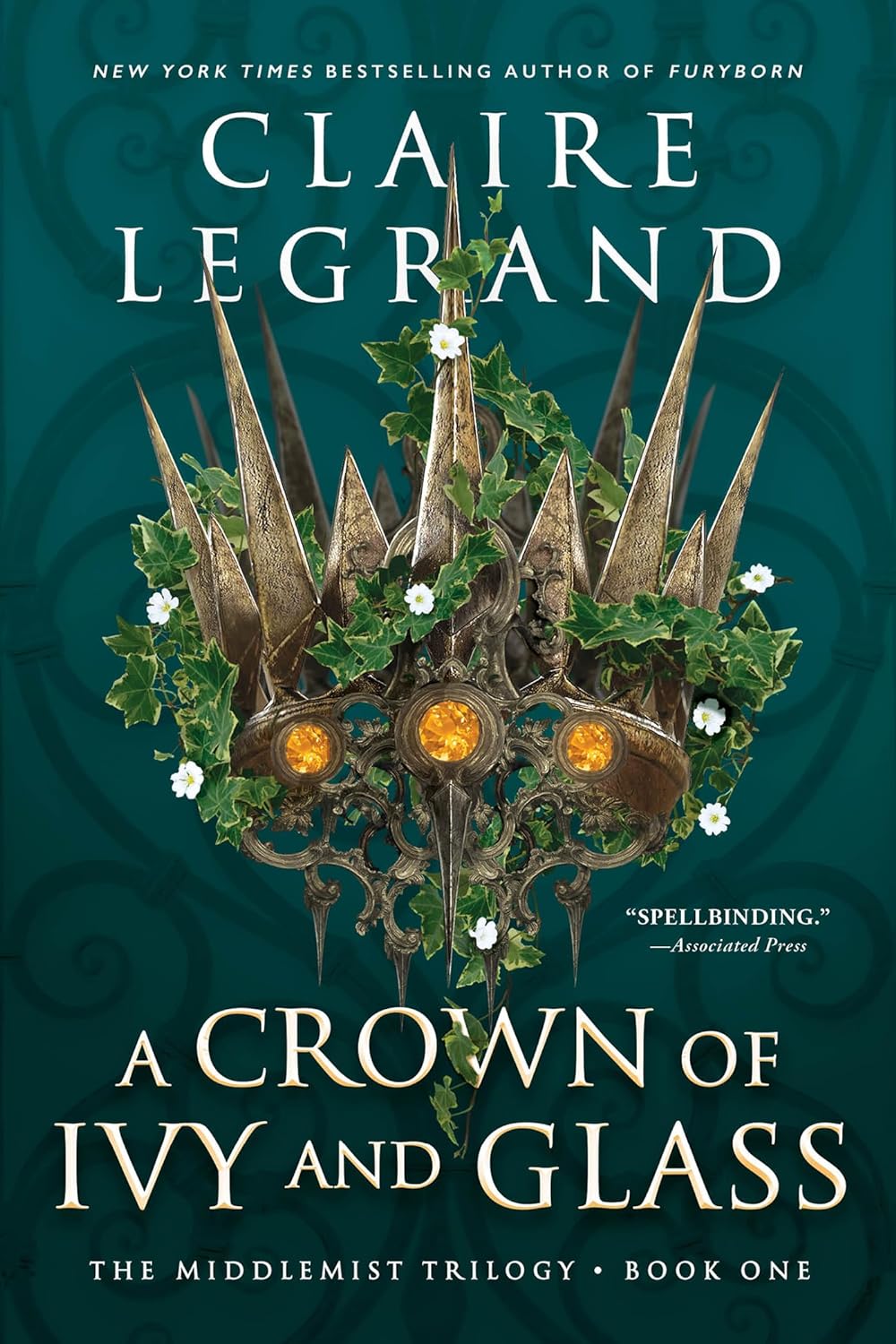
A Crown of Ivy and Glass by Claire Legrand is the first book in The Middlemist Trilogy. It’s an adult romantasy with a gothic vibe and a sweeping, expansive fantasy world that is both complex and fascinatingly dark.
Lady Gemma Ashbourne has no magic, but she seemingly has everything else. She is beautiful, fashionable, and from a powerful family. She gets invited to all the best parties, and her family is Anointed by the gods, giving them impressive magical abilities. But Gemma is different.
Not only does she not have magic, but even the presence of magic causes her intense pain. If she is exposed to too much magic too fast, she becomes seriously ill. She also suffers from debilitating panic attacks and self-harms to break herself out of them. It’s not a perfect life, but it is all Gemma has ever known.
When a mysterious stranger, Talan d’Astier, arrives at a party, Gemma’s father instructs her to befriend him. She feels an instant connection with this beautiful man. His family is ruined, and he blames a demon, asking for her help to find him and defeat him. What’s in it for her? The demon just might be able to cure her pain and her panic. When things get dangerous, Gemma turns to her sisters to help, secrets are revealed, and everything Gemma thought she knew is turned upside down.
The highlight of A Crown of Ivy and Glass was the wonderful world-building and the rich mythology behind it. The magical system is gorgeous, and every new reveal of magic and what it is capable of is more interesting than the last.
This book is without question a slow burn, both in romance and in reading experience. It takes some time to really settle into itself and get going, but once it does, it takes off into a sweeping story filled with danger and drama.
Gemma Ashbourne is a deeply flawed heroine. She is unabashedly vain. She revels in her privilege, and admits, if only to herself, that she is prone to selfish cowardice. Talan also doesn’t fit the usual mold of the romantasy hero, a confident, bordering on cocky, possessive hunk. Talan is instead a little shy at times, a little soft-spoken, and tries hard to impress and woo Gemma.
I suspected she was pulling a classic Sarah J. Maas, and Talan wasn’t the real love interest here. I will avoid spoilers, but let’s just say the author breaks the genre-standard mold in one way or another.
The chemistry between the main characters was a little lacking. You didn’t necessarily feel the intense connection between them that the author was trying to impart, and it lacked some of the figurative magic readers expect from the genre.
All of these flaws are valid reasons Goodreads reviewers seemed to largely hate this book but honestly, I liked it overall. The anxiety, chronic pain, and mental health aspects felt very authentic from someone who suffers from many of the same issues as the female main character. For that alone, A Crown of Ivy and Glass is worth reading for me.
But beyond that, Gemma is utterly unlikeable. Especially at the beginning. Lots of people hated this, and hated her, but I absolutely adore an unlikeable female main character. Women don’t have to be all badass and sweet and noble to have stories worth telling.
It seems like a mistake here was marketing this book as a combination of Bridgerton and A Court of Thorns and Roses. Besides the presence of a trio of sisters, it really is quite different from both of those stories. If it had been marketed differently, expectations might have been different for many readers going into this story. For me, it was more reminiscent of Kerri Maniscalco’s Throne of the Fallen or Kristen Ciccarelli’s Heartless Hunter.
It’s not that these reviewers are not making salient points, it’s just that these flaws are worth overlooking. I can see why people disliked this book but I am not one of them, and I will be reading the next one when it comes out this fall.
Spice: 3
Writing: 3.5
Note: some of the links included here are Amazon Affiliate links, which means if you purchase through said links, The Nora Theory gets a cut.


Leave a Reply